An Bang: the beach closest to the old town
A short bicycle ride from Hoi An's lanterns, a fishing village meets the sea. An Bang has become the beach most visitors to Hoi An mean when they say the beach.

- From the old town
- About 5 km
- The water
- Varies by season
- Best months
- March to August
- Getting there
- Bicycle or taxi north from Hoi An
Five kilometres north of Hoi An's old town, the road through the rice fields reaches the sea at a fishing village called An Bang. For years it was a quiet place where fishermen kept their boats. As the sea took the sand from Cua Dai, Hoi An's traditional beach to the east, An Bang became the beach people cycled to instead, and today it is the liveliest stretch of sand near the town.
Getting there through the fields
One of the pleasures of An Bang is the journey. From the old town, quiet roads lead north across the rice fields and over small bridges, past water buffalo, vegetable gardens and the village of Tra Que, known for its herbs. By bicycle, it takes around twenty to thirty minutes at an easy pace. Many places in Hoi An rent bicycles in general terms, and most beach places have somewhere to lock them, sometimes for a small fee.
Taxis and app cars also make the trip quickly, and are the better choice after dark or in the heat of midday.
The beach
The beach at An Bang is fine pale sand, gently sloping into the sea, with basket boats drawn up at the edges and the green line of the Cham Islands on the horizon. Behind the beach, a row of restaurants and bars, in general terms, stretches along the sand, with sunbeds and umbrellas in front. Away from the central stretch, the beach becomes quieter, with fishing boats and local families.
Erosion has affected An Bang too. In places, the beach has narrowed, and sandbags and other defences protect the buildings behind. The width of the sand varies from year to year and season to season; recent pictures are a better guide than old ones.
Swimming at An Bang
In the calm months, from roughly spring to late summer, the water at An Bang is often gentle and warm, especially in the mornings. In the rough months, from about September into the early winter, big waves and strong currents make swimming dangerous, and red flags are common. Lifeguards watch the main stretch during the busier season, in general terms. Swim between the flags where they are set, and never swim when red flags fly. More in swimming safely on an open coast.
Staying at An Bang
Staying in or near An Bang gives you the beach in the morning and the old town in the evening, which is why it has become so popular. The village has grown a cluster of small places to stay, in general terms, many in the lanes behind the beach. A few things to think about:
- Beachfront or village lanes: the lanes are quieter and cheaper; the beachfront can be noisy in the evenings.
- Erosion: check recent photos of the beach in front of where you plan to stay.
- Getting to town: a bicycle by day, a taxi after dark.
- Season: in the rough months, the beach is less inviting, and the town is the main draw.
The fishermen still work from the northern and southern ends of the beach, where basket boats are pulled up on the sand.
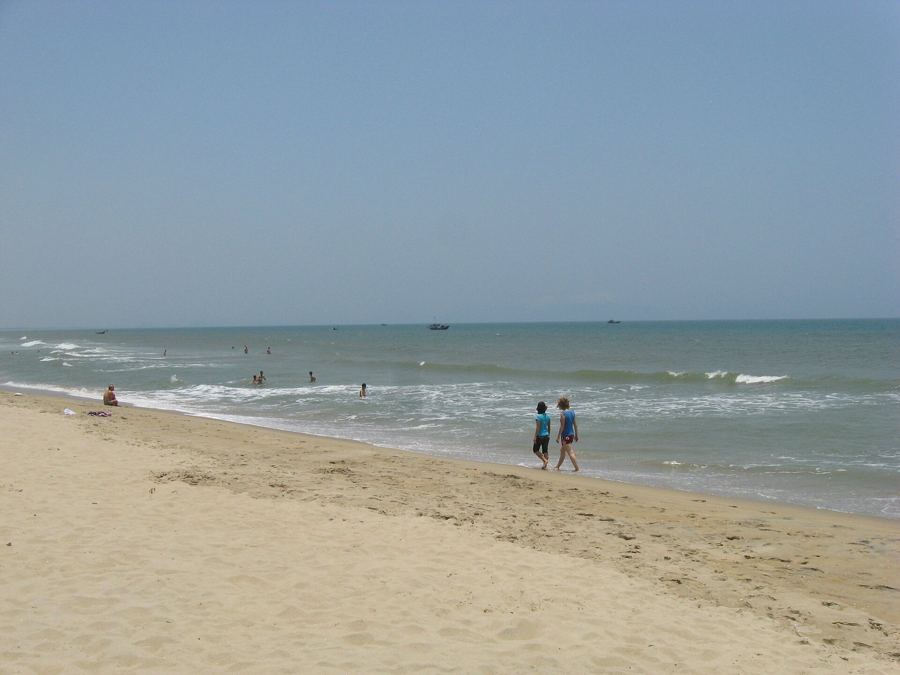
An Bang's rise has been quick. In the space of a few years, a quiet fishing beach became one of the best known in Vietnam, with beach bars, restaurants and places to stay crowding along its front. The change brought work and income to the village, but also pressures: noise, rubbish, and building close to a shoreline that is already under attack from the sea. Walking a little away from the busiest stretch, towards the fishing boats at either end, gives a sense of the village as it was.
The best hours at An Bang are early and late. In the morning, the beach is calm and the light soft, with fishermen at work and local people swimming. In the late afternoon, the heat eases, families arrive, and the Cham Islands glow on the horizon. In the middle of the day, the sun is fierce, and most people retreat to shade.
Sunbeds and umbrellas in front of the beach businesses are often free to use if you buy food or drinks, in general terms; ask first. Away from them, bring your own shade.
The beach is also a good starting point for walks. North, the sand runs on towards Ha My, getting quieter with every kilometre. South, it leads towards Cua Dai and the river mouth, past stretches of sandbags and defences that show how the shore is changing. A walk in either direction at sunrise, with the sun coming up over the sea and the islands, is one of the simplest pleasures of a stay here.
On Sundays and public holidays, families from Hoi An and the surrounding villages come to An Bang in large numbers, and the beach takes on a festive feel, with picnics, games and swimming in the shallows. Weekdays are calmer, especially in the mornings. Outside the main season, the beach can be almost empty, and some businesses close. Rubbish can be a problem after busy days, and local groups organise clean-ups; leave nothing behind, and pick up a piece of plastic or two if you can.
On a clear day, the Cham Islands seem close enough to swim to, though they lie well offshore. Watching them change colour with the light, from grey-blue at noon to pink at dusk, is part of the rhythm of a stay here. Boats to the islands leave from the river mouth at Cua Dai, a short ride south.
Parking for bicycles and scooters is offered by households along the lanes behind the beach for a small fee, and it is worth using rather than leaving a bike loose on the sand. Keep the ticket you are given. If you come by taxi in the evening, agree a pick-up time in advance or use a ride-hailing app, as cars can be scarce once the sun has set and the crowds head home.
The village behind the beach
An Bang is still a village, with a temple, small shops, houses and family graves among the sandy lanes. Walk respectfully, dress modestly away from the beach, and keep noise down in the lanes at night. The fishermen still work from the northern and southern ends of the beach, where basket boats are pulled up on the sand.
For the beaches to the north, quieter and wider, see Ha My. For the story of what happened to Cua Dai, and why An Bang took its place, see Cua Dai: the beach the sea took back. And for a way to spend a rough-weather day nearby, the basket boats of Cam Thanh are described in Cam Thanh.